Pearson Edexcel · GCSE · Mathematics
Course version: 1MA1 · Version from Mar 2026
Geometry and measures - Mensuration and calculation: know and apply the sine rule a/sin A = b/sin B = c/sin C , and cosine rule a² = b² + c² – 2bc cos A, to find unknown lengths and angles (Higher tier only)
When a triangle has no right angle, the sine and cosine rules turn unfamiliar diagrams into solvable calculations. Learn to choose the right rule, show mark-worthy working and handle obtuse angles, then test yourself with worked examples, original Edexcel-style questions and a ten-minute tutor podcast.
- 12 min read
- 5 worked examples
- 6 practice questions
- 10 key terms
Try the lesson
The start of the Geometry and measures - Mensuration and calculation: know and apply the sine rule a/sin A = b/sin B = c/sin C , and cosine rule a² = b² + c² – 2bc cos A, to find unknown lengths and angles (Higher tier only) lesson, made from checked teaching notes for this specification point.
Have a go first
In triangle ABC, side a = 10 cm, side b = 12 cm and side c = 15 cm. Use the cosine rule to find angle B, giving your answer to 1 decimal place.
There is more to this lesson
The full lesson goes on to check your understanding and help you earn the marks. Create a free account to carry on, with your progress saved.
7 days Premium · Then the free plan continues · No card, no charge
Check what you remember
Read the wording for your board, then hide it and explain Opposite side in your own words. Rough notes are fine. This is a self-check, with no mark or grade.
Reference: Pearson Edexcel
The side joining the two vertices other than the vertex of the specified angle.
Study Notes

Overview
A bridge, a sailing route or a triangular field rarely provides a convenient right angle. The sine rule and cosine rule let you calculate missing lengths and angles in these triangles without measuring the drawing. This is Higher-tier-only content, Pearson Edexcel GCSE Mathematics 1MA1, G22. A reliable solution begins by recognising the information given, not by guessing which formula looks familiar. 1
You will learn to match sides with opposite angles, select the appropriate rule, rearrange accurately and check whether your answer fits the triangle. These skills combine with algebra, angle facts, bearings, similarity and the area of a triangle. Typical questions ask candidates to work out a side, calculate an angle from three sides, interpret an obtuse angle, or use a shared diagonal to solve a second triangle.
Most numerical calculations suit calculator Papers 2H and 3H, although exact-value reasoning can appear on non-calculator Paper 1H. The current Higher formula sheet supplies both rules; candidates must still select and apply them correctly. All questions and mark allocations in this guide are original, illustrative Edexcel-style practice, not official Pearson questions or mark schemes. 2 3
Key Concepts
1. Label opposite partners before calculating
In triangle ABC, a = BC, b = AC and c = AB. Angle A is at vertex A, so its opposite side joins the other two vertices, B and C. The letters identify relationships, not positions on the page. Rotating a diagram changes none of them.
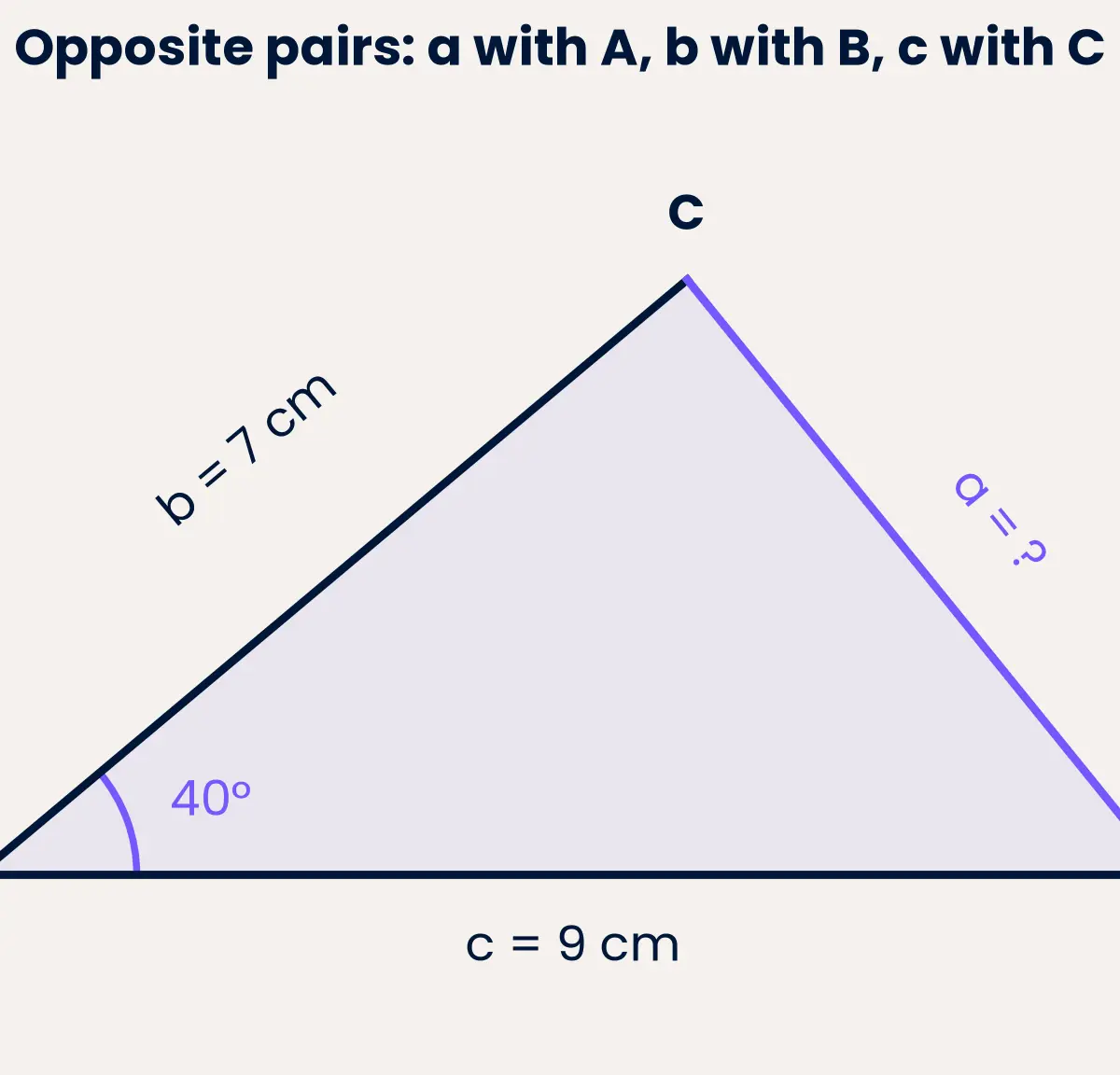
The diagram shows b = 7 cm and c = 9 cm meeting at A = 40°. Side a is opposite that angle. This is exactly the arrangement required to calculate a using the cosine rule. Notice that neither known side is opposite A.
The longest side faces the largest angle. Equal sides face equal angles. These facts do not replace calculation, but they expose many incorrect answers. Cover and recall: point to angle B, then identify its opposite side without looking at the explanation.
2. Select the rule from the information
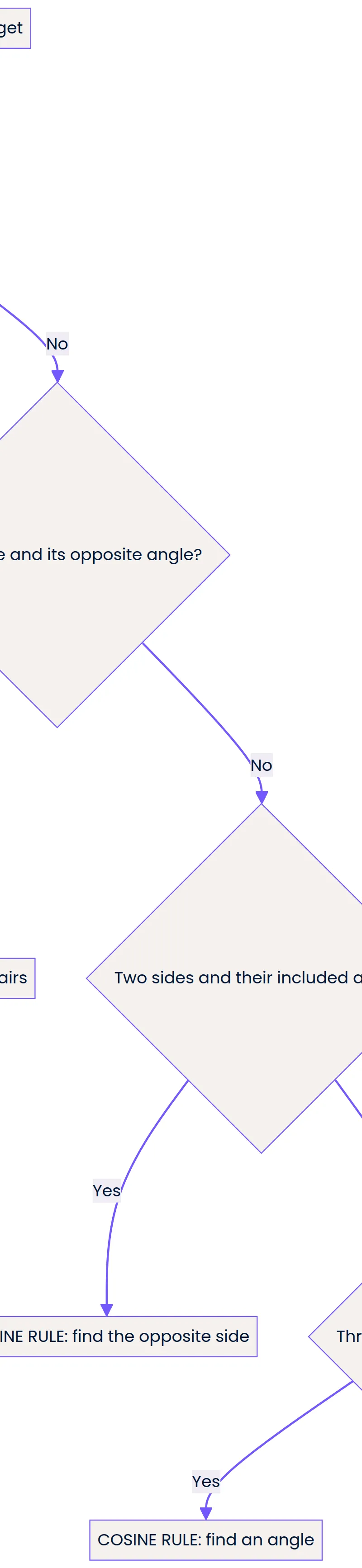
Use the sine rule when you have a complete known side-and-opposite-angle pair, together with another side or angle that lets you form a second pair. If two angles are given, you may first calculate the third using the 180° angle sum.
Use the cosine rule to find a side when you know two sides and the included angle, meaning the angle between them. Use its rearranged form to find an angle when all three sides are known. Knowing two sides and some other angle does not automatically justify the direct cosine-rule side calculation.
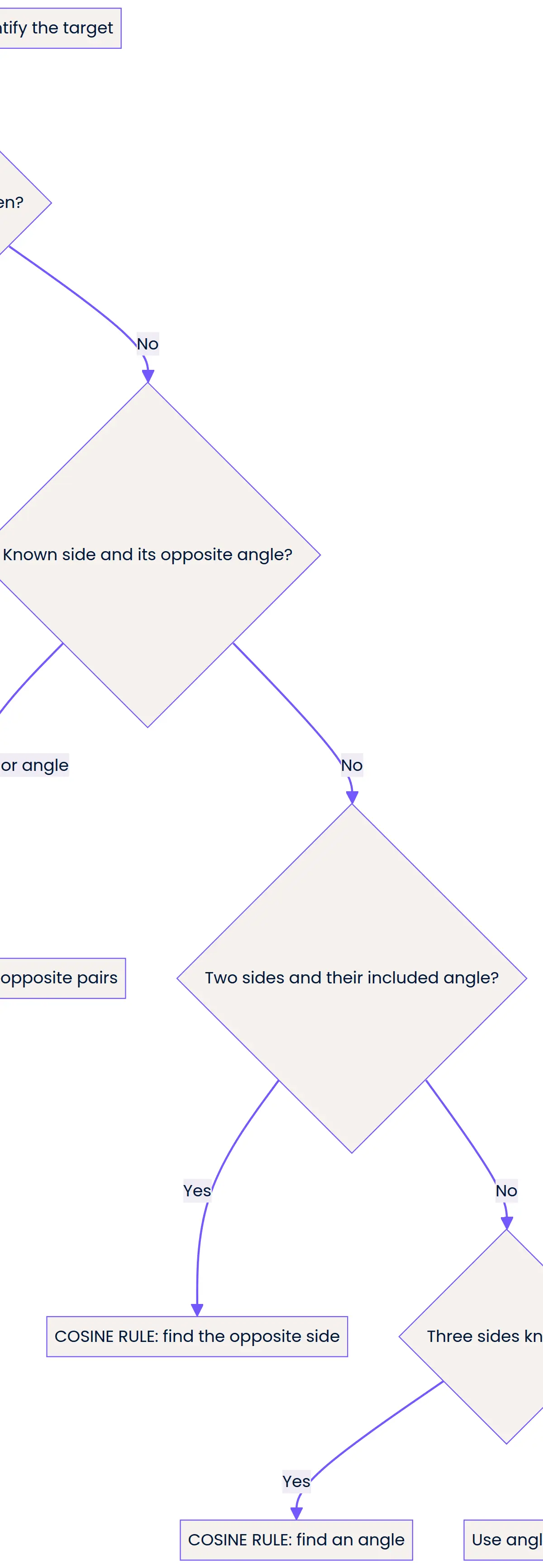
For a right-angled triangle, Pythagoras or SOHCAHTOA is usually shorter. The sine and cosine rules remain valid, but a simpler correct method reduces opportunities for error. If neither rule is ready to use, look for angle facts, a diagonal or another triangle supplying missing information. Why does this work? Each usable equation must contain only one unknown at the calculation stage.
3. Sine rule: find a missing side
The sine rule states that a/sin A = b/sin B = c/sin C. Select two fractions, not all three. Keep each side paired with its opposite angle. For example, when A = 38°, a = 9 cm and B = 72°:
b/sin 72° = 9/sin 38°
b = 9 sin 72° / sin 38° = 13.90294665… cm
Therefore b = 13.9 cm to 3 significant figures. It is longer than a, as expected because B is larger than A. The multiplication by sin 72° must apply to the whole right-hand fraction.
The rule works because the ratios of a side length to the sine of its opposite angle are equal within one triangle. One justification uses the area: K = ½bc sin A = ½ac sin B. Equating these expressions and cancelling gives a/sin A = b/sin B. You do not need to prove this in a routine calculation, but it explains why opposite pairing matters.
4. Sine rule: find an angle and test the alternative
For an angle, the equivalent form sin A/a = sin B/b is often easier to rearrange. With A = 30°, a = 7 cm and b = 10 cm:
sin B = 10 sin 30° / 7 = 5/7.
The calculator gives B₁ = sin⁻¹(5/7) = 45.58469140…°. However, sin θ = sin(180° − θ), so B₂ = 134.41530860…° is another candidate. Both are possible here because each leaves a positive third angle when combined with A = 30°. If the question states that B is obtuse, choose 134.4° to 1 decimal place.
Do not automatically report two answers in every question. Reject an alternative if it contradicts the stated acute or obtuse condition, makes the angle sum reach or exceed 180°, or conflicts with other given information. If the calculated sine exceeds 1, the stated measurements cannot form that triangle, assuming the substitution is correct.
This is the ambiguous case: side-side-angle information can sometimes describe two different triangles. What if? If A were already obtuse, could the other angle also be obtuse? No, their sum would exceed 180°.
5. Cosine rule: find the side opposite the included angle
The cosine rule is a² = b² + c² − 2bc cos A. Here A lies between b and c, and a is opposite A. Substituting b = 7 cm, c = 9 cm and A = 40° gives:
a² = 7² + 9² − 2 × 7 × 9 × cos 40°
a² = 130 − 126 cos 40° = 33.47840017…
a = √33.47840017… = 5.79 cm to 3 significant figures.
The value 33.4784… is a², measured in cm², not the required length. Taking the positive square root restores centimetres. A physical side length cannot be negative.
On your calculator enter √(7² + 9² − 2 × 7 × 9 × cos(40)). Do not enter (7² + 9² − 2 × 7 × 9) × cos(40). That incorrectly applies the cosine to the whole expression rather than just the product term.
6. Cosine rule: find an angle from three sides
Rearranging gives cos A = (b² + c² − a²)/(2bc). The side opposite the target angle is the side whose square is subtracted in the numerator. Put the entire numerator and the entire denominator in brackets when typing.
For a = 12 cm, b = 7 cm and c = 9 cm:
cos A = (49 + 81 − 144)/126 = −1/9.
A = cos⁻¹(−1/9) = 96.4° to 1 decimal place.
A negative cosine indicates an obtuse triangle angle, so this result is sensible. Unlike inverse sine, inverse cosine returns the unique triangle angle between 0° and 180°. Do not replace it with its supplement. If the ratio falls outside −1 to 1, check the labels, arithmetic and whether the sides satisfy the triangle inequality.
7. Understand the link to Pythagoras
At A = 90°, cos A = 0, so the cosine rule becomes a² = b² + c². For an acute included angle, cos A is positive and the adjustment subtracts from b² + c². For an obtuse angle, cos A is negative, so subtracting 2bc cos A increases the result. This explains why the same two sides have a larger opposite side when opened to a wider angle.
A second justification drops a perpendicular from C onto AB. For acute A, the horizontal projection is b cos A and the height is b sin A. Pythagoras gives a² = (c − b cos A)² + (b sin A)². Expanding and using sin² A + cos² A = 1 produces the cosine rule. This derivation is enrichment, not an extra formula to learn for routine G22 questions.
8. Multi-step triangles, bearings and precision
A quadrilateral becomes two triangles when you draw a diagonal. Find the diagonal using the triangle with enough information, then carry the unrounded value into the other triangle. In a solid, identify the actual plane containing the required angle; a perspective sketch may hide it.
Bearings are measured clockwise from north. A bearing is not necessarily an interior triangle angle. Use parallel north lines, angles on a straight line and triangle angle sums to find the interior angle before substituting. A diagram marked not accurately drawn must not be measured to obtain your answer.
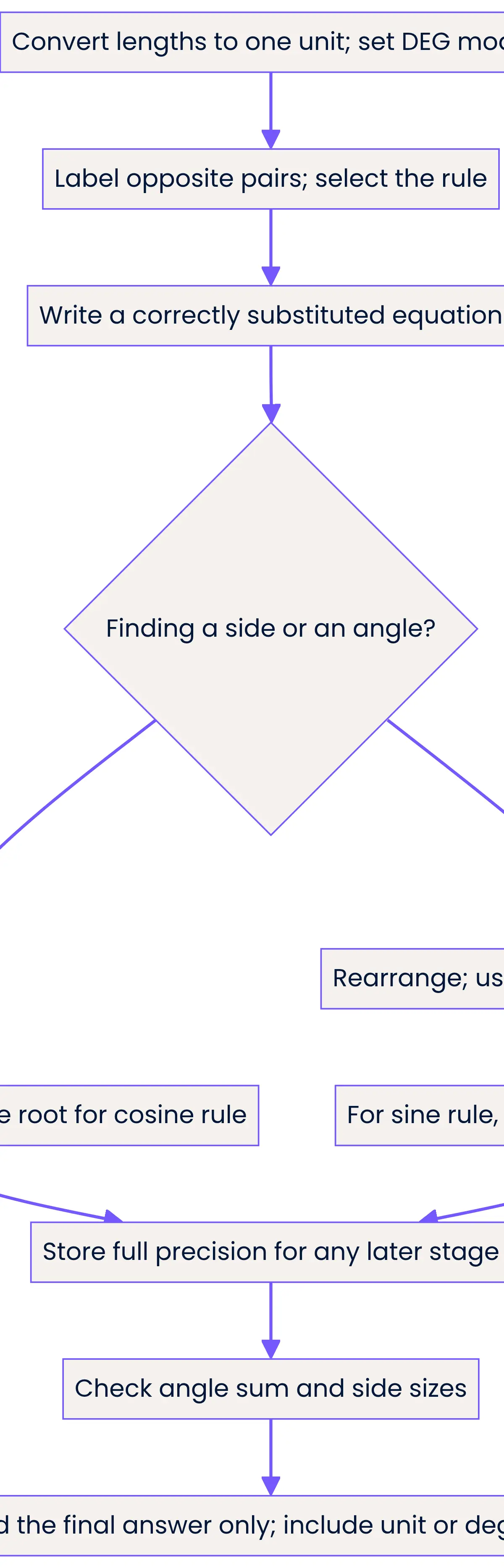
Set the calculator to DEG, not RAD. Use sin⁻¹ or cos⁻¹ for angles: these mean inverse functions, not 1/sin or 1/cos. Store intermediate results with the calculator's memory or answer key. Round once, at the requested final accuracy.
Mathematical/Scientific Relationships
Given on formula sheet: a/sin A = b/sin B = c/sin C; a² = b² + c² − 2bc cos A; triangle area K = ½ab sin C; Pythagoras x² + y² = h² in a right-angled triangle; sin θ = opposite/hypotenuse, cos θ = adjacent/hypotenuse and tan θ = opposite/adjacent. These appear on Pearson's 2026 Higher sheet. Pearson confirms unchanged sheets and continued provision under the current specification; practise with your examination series' official insert. 2 3
Given on formula sheet, by rearranging a printed rule: b = a sin B/sin A; B = sin⁻¹(b sin A/a), subject to the supplementary-angle check; a = √(b² + c² − 2bc cos A); A = cos⁻¹((b² + c² − a²)/(2bc)). These rearrangements are not printed separately. Candidates must be able to derive or use them; the labels do not mean extra lines are supplied.
Must memorise as angle facts, not separately printed formulae: A + B + C = 180° and the supplementary candidate 180° − B₁. Understand the sine symmetry that justifies that candidate. For exact-value non-calculator reasoning, know the relevant specification G21 values, including sin 30° = ½, cos 60° = ½ and cos 90° = 0. From an obtuse supplementary angle, cos 120° = −½. 1
All side letters represent positive lengths in the same unit. A, B and C are interior angles measured in degrees. K is area. In the area rule, C is included between sides a and b. The unit of a calculated side is the input length unit; area uses squared units.
Units, diagrams and data skills
Use 1 m = 100 cm, 1 cm = 10 mm and 1 km = 1000 m. Thus 2.4 m and 75 cm must become 240 cm and 75 cm, or 2.4 m and 0.75 m, before calculation. Squaring does not remove inconsistent units. For linked area questions, 1 m² = 10,000 cm², not 100 cm².
Read vertex names carefully: angle ABC is at B, between BA and BC, and its opposite side is AC. No graph plotting is normally needed in a routine G22 calculation. If a sine graph is provided in a linked question, its equal heights at θ and 180° − θ explain the two possible angles; read both relevant intersections and then check triangle conditions.
Practical Applications
Surveyors can calculate an inaccessible distance across a river from a measured baseline and angles. Route planners use two journeys and the angle between them to find the direct distance. Designers use triangular braces to relate strut lengths to opening angles. In every case, the exam skill is to translate the situation into a labelled triangle with consistent units. There is no required practical for this GCSE Mathematics topic.
Marks, command words and independent study
A substituted equation makes a candidate's method visible. Method or process marks may remain available after arithmetic errors, according to the individual scheme; a bare incorrect answer provides little evidence to credit. Do not assume a universal mark for merely naming the rule.
A genuine example is November 2023, Paper 1H, Question 20: Pearson awards three process marks through a cosine-rule solution and an accuracy mark for 120°. Its scheme explicitly gives zero for the correct answer without supportive working. This illustrates why instructions matter, not a rule that every cosine question has four marks. 4
For work out/calculate, show substitution, rearrangement and the final answer. For show that, justify the supplied result from the data without treating it as a starting assumption. For explain, connect your reason to the actual triangle. Attempt the practice questions with answers covered, mark them, then redo only the missed methods tomorrow and again a week later.
Ten-minute tutor podcast
Listen with a calculator and paper. Use the short working and recall pauses to reproduce the examples rather than just hearing the answers. Episode structure: 00:00 introduction; 01:00 core concepts; 06:00 exam tips and mistakes; 08:00 recall quiz; 09:00 summary. The full transcript appears in podcast_script.
References
Worked Examples
5 worked examples — open one to explore the question and available guidance.
Practice Questions
Try the question, then reveal an answer plan or example response
Original Edexcel-style question, 3 marks. In triangle ABC, A = 42°, B = 75° and a = 8 cm. Work out b to 3 significant figures. Show your working.
Hint: Find the complete opposite pair. This is introductory Higher-tier practice, not Foundation-tier syllabus content.
Original Edexcel-style question, 3 marks. Two sides of a triangle are 6 cm and 11 cm. Their included angle is 58°. Calculate the third side x to 3 significant figures. Show your working.
Hint: The given angle is between the known sides.
Original Edexcel-style question, 4 marks. A triangle has a = 13 cm, b = 8 cm and c = 10 cm. Work out angle A to 1 decimal place. Show your working.
Hint: The side whose square is subtracted must be opposite A.
Original Edexcel-style question, 4 marks. In triangle ABC, A = 35°, a = 12 cm and b = 9 cm. Calculate B to 1 decimal place. Explain why the supplementary candidate is not valid.
Hint: Check each candidate against A + B < 180°.
Original Edexcel-style question, 5 marks. In triangle ABC, A = 25°, a = 8 cm and b = 12 cm. Work out both possible values of B to 1 decimal place. Show why both are possible.
Hint: Find the inverse-sine value, then its supplement. Check that each leaves a positive third angle.
Original Edexcel-style synoptic question, 6 marks. Triangle ABC has BC = 13 cm, AC = 8 cm and AB = 10 cm. Work out angle BAC to 1 decimal place, then calculate the area of ABC to 3 significant figures. Show your working.
Hint: Use G22 to find the angle between the 8 cm and 10 cm sides, then use the G23 area rule.
Exam technique
How to turn what you know into marks
How to approach the question
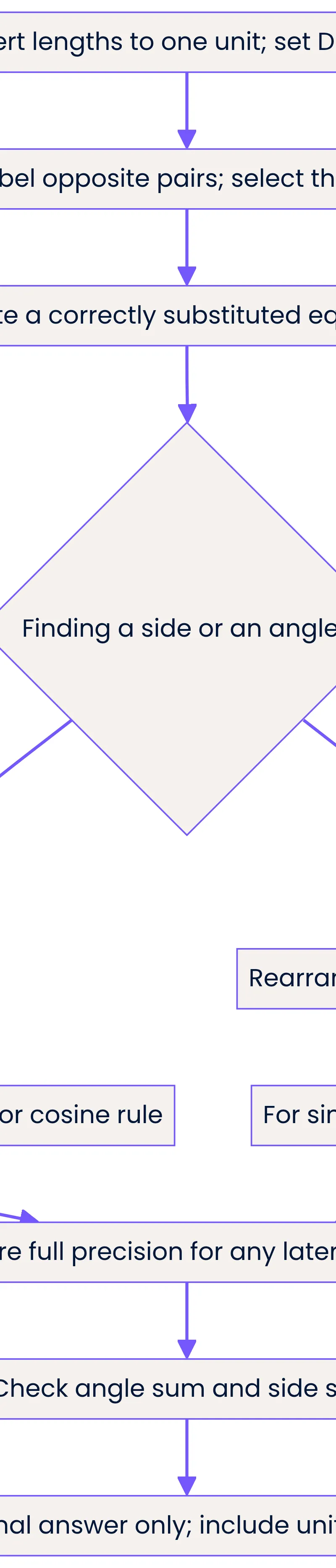
Identify the target side or vertex. Convert lengths to one unit. Label opposite pairs and mark the included angle if relevant. Count known sides and angles, choose the rule, set DEG mode and form an equation with one unknown. In linked questions, find the useful diagonal or angle first.
How to structure your answer
For a routine 3-mark length, show the substituted equation, a complete solving method and the final length. For a 4-mark angle, show substitution, rearrangement, inverse-function use and the final angle, including any necessary sine supplement. For a 6-mark linked problem, label each triangle and show how the unrounded first result feeds the second. These are illustrative structures; official allocations vary.
Timing
Each Pearson Edexcel paper is 90 minutes for 80 marks, averaging 1.125 minutes per mark. As a flexible guide, allow about 3–4 minutes for 3 marks, 4–5 minutes for 4 marks and 6–7 minutes for 6 marks. Leave checking time; this is revision advice, not an official time limit for individual questions.
Common pitfalls
- Mismatching opposite pairs: mark the angle and the side across from it before writing a fraction.
- Using a non-included angle in the direct cosine-rule side formula: check that the two known sides actually meet at the given angle.
- Applying cosine to the whole sum: only the product 2bc is multiplied by cos A.
- Stopping at a²: take the positive square root to obtain a length.
- Confusing inverse sine with reciprocal sine: use the calculator's inverse function to obtain an angle.
- Missing an obtuse sine-rule solution: test the supplement against the angle sum and all stated conditions.
- Using RAD mode or early rounding: choose DEG and retain full intermediate precision.
- Mixing units or misreading the target vertex: convert first and remember that angle ABC is at B.
What the command words want
- Compare
- Compare the requested mathematical quantities explicitly, such as which side is longer and how the opposite angles support that conclusion.
- Explain
- Give a mathematical reason linked to the data, for example: the cosine rule is suitable because three side lengths are known.
- Describe
- Describe the mathematical feature precisely, for example that the given angle lies between the two known sides. This is less common than work out in routine G22 questions.
- Evaluate
- In Mathematics, evaluate means find the value of an expression. It does not mean discuss advantages and disadvantages.
- Work out
- Carry out a valid method. Show enough intermediate working to make substitution, rearrangement and any second triangle clear.
- Calculate
- Write the substituted equation, solve it and give the answer at the stated accuracy with its unit or degree sign.
- Show that
- Demonstrate the supplied result from the given measurements. Keep sufficient precision and do not use the answer to be shown as an assumed starting value.
- State/Give
- Provide the requested fact or value concisely. Add the correct unit where relevant; do not invent a calculation if none is requested.
Watch or listen (optional)
Test your understanding of Geometry and measures - Mensuration and calculation: know and apply the sine rule a/sin A = b/sin B = c/sin C , and cosine rule a² = b² + c² – 2bc cos A, to find unknown lengths and angles (Higher tier only)
Active recall beats re-reading. Take an instant quiz now to test what you’ve learned and lock it into long-term memory.
7 days Premium · Then the free plan continues · No card, no charge